If you have had FURS — laser removal of a kidney stone, or the operation is still ahead of you, there is a good chance you will come across the words JJ stent or ureteral stent. In my experience, it is the stent — not the operation itself — that raises the most questions, anxiety and discomfort. The stone is gone, the patient has gone home, and then the frequent urination begins, the pink urine, the dull flank ache when passing water — and the question: "Is this normal?"
In this article I will answer what patients ask most often: what a JJ stent is, why it is placed at all, how long it stays, which symptoms are expected and which are not, and how it is removed — today without general anaesthesia, in the office, in a few minutes.
What is a JJ stent?
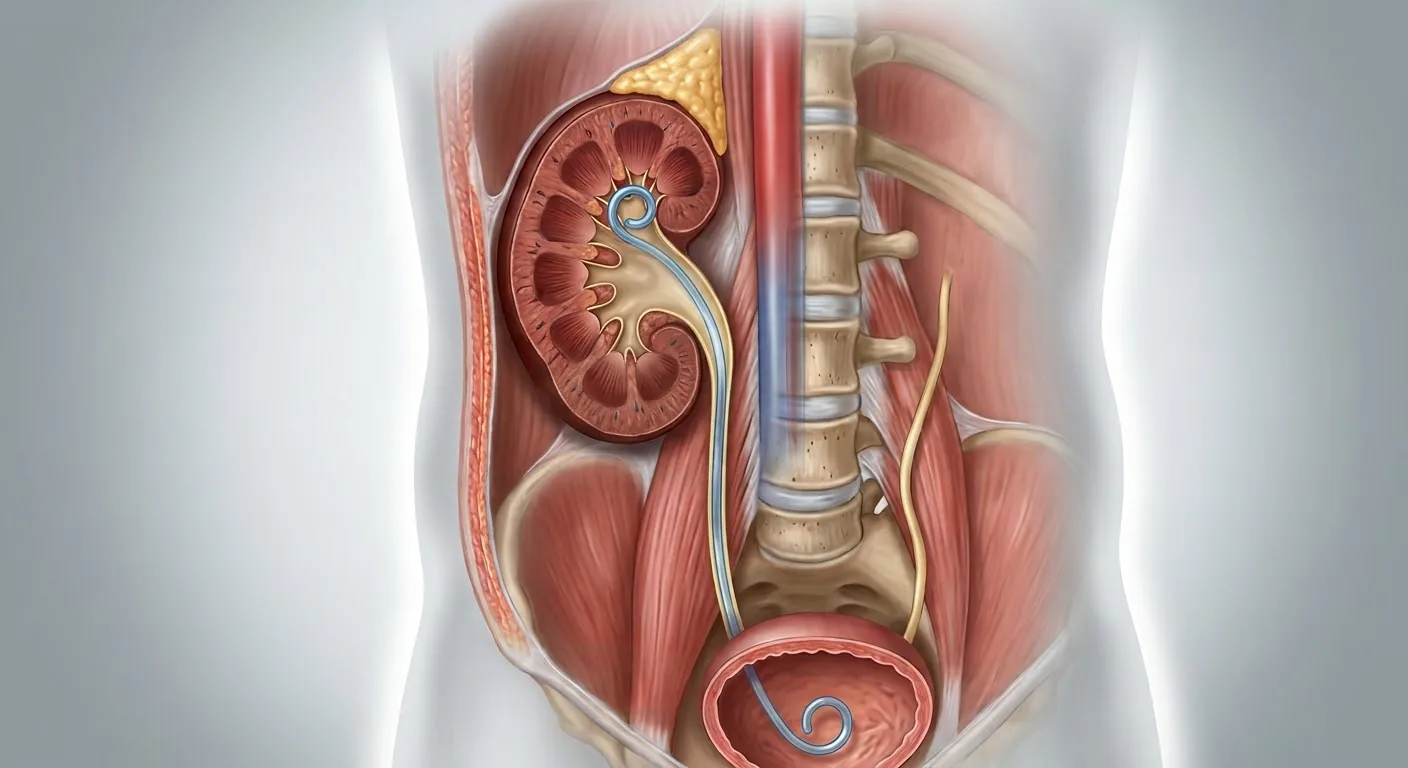
A JJ stent (double-J stent, ureteral or ureteric stent) is a thin, soft, hollow tube about 22–28 cm long and only a few millimetres wide, which is placed in the ureter — the channel that connects the kidney to the urinary bladder. Both ends of the stent are curled into a "J" shape (hence "double J"): one end sits in the kidney, the other in the bladder, so the stent holds itself in place.
The stent is entirely inside the body — nothing is visible from the outside, there is no bag and no dressing. It is made of soft silicone or polyurethane and is intended for temporary use.
Its only job is to keep the ureter open and make sure that urine drains freely from the kidney into the bladder.
Why is a JJ stent placed after FURS?
First and most important: a JJ stent is not a compulsory part of every FURS. In simpler procedures, when the stone is small and the ureter is wide and undamaged, a stent is often not needed. I make the decision during the operation itself, based on what I see.
I place a stent when there is a clear reason to:
- Swelling of the ureter after instrumentation. FURS is performed through the ureter, a narrow and sensitive channel. After the instrument has passed, the wall of the ureter can swell temporarily, and without a stent the urine from the kidney could become blocked — causing severe pain similar to renal colic.
- A larger stone or several stones. When the laser fragments a larger stone, many small fragments ("dust") remain that still have to pass with the urine. The stent makes their passage easier.
- Residual fragments that need to be dealt with in a second procedure.
- A narrow ureter — when the instrument is difficult to pass, a stent is sometimes placed 1–2 weeks before the operation so that the ureter "passively" widens and allows safe access to the kidney (so-called pre-stenting).
- Infection, a single functioning kidney, pregnancy or other situations in which even a short-term blockage of the kidney is unacceptable.
In short: the stent is placed to protect the kidney while the ureter recovers and while stone fragments pass. It is a safety measure, not a complication.
How long does a JJ stent stay in?
After FURS the stent usually stays in for 1 to 4 weeks — depending on why it was placed. For simple swelling of the ureter a few days to two weeks is enough; for a heavier stone burden or a planned second procedure, longer.
You receive your removal appointment at discharge or at the follow-up visit. That appointment matters.
The forgotten stent — the only real danger
A JJ stent is a temporary solution. If it stays in the body for months, urinary salts build up on it (encrustation), it blocks, becomes a source of infection and eventually turns into a "stone" itself that is difficult to remove. This is one of the most unpleasant situations in urology — and it is entirely preventable by one thing: attending your scheduled removal.
Every patient of mine receives written information stating that they have a stent and the date by which it must be removed. If for any reason you cannot come at the agreed time — call, and we will reschedule. Never simply "forget" a stent.
How does a JJ stent feel — what is normal?
This is the part that surprises patients most, because hardly anyone talks about it in advance. Most people with a stent feel some kind of discomfort, and it has a simple cause: the lower end of the stent sits in the bladder and irritates its lining, and the stent temporarily disables the natural "valve" between the bladder and the ureter.
Expected, normal symptoms:
- Frequent urination and urgency — the bladder "thinks" it is full as soon as it fills a little.
- Burning when urinating, especially at the end of the stream.
- A dull ache in the flank (on the side of the stent) precisely while you urinate. This is characteristic: during urination, pressure from the bladder is transmitted up the stent towards the kidney. It lasts a few seconds and passes.
- Pink or slightly red urine, particularly after physical activity, a long drive or prolonged sitting. The stent moves and gently irritates the lining.
- A feeling that the bladder is not empty and mild pressure above the groin.
Symptoms are most pronounced in the first few days and ease off in most people as the body adjusts. They get worse with exertion and settle with rest.
What helps
- Moderate fluid intake — about 2 litres a day. More is not better: drinking excessively only worsens the frequent urination.
- Medication. There are drugs proven to reduce stent symptoms — most often alpha-blockers (which relax the ureter and the bladder neck), and if needed bladder-calming medication. Don't suffer in silence — tell me if the symptoms are severe; the therapy can be adjusted.
- Painkillers as recommended (paracetamol, and if kidney function is normal, non-steroidal anti-inflammatories).
- Avoid strenuous physical activity — the gym, running, heavy lifting. Light walks and normal work are fine.
- Don't hold your urine — a full bladder increases reflux towards the kidney and the pain.
When to call your doctor — and when it is urgent
The symptoms in the previous section are unpleasant but harmless. The following are not.
Contact us immediately (the same day):
- Temperature above 38 °C, fever, shivering — a possible sign of kidney infection. With a stent in the body, an infection is never something to wait out.
- Severe flank pain that does not respond to the prescribed painkillers, with nausea and vomiting.
- Heavy bleeding with clots or dark, wine-coloured urine that does not clear even with fluids.
- Inability to urinate.
These situations are rare, but it is important to recognise them. When in doubt — call; that is always better than waiting.
How is a JJ stent removed?
This is the question patients ask with the most apprehension — and here I have the best news in the whole article.
Removal with a flexible cystoscope
I remove the stent by flexible cystoscopy — in the office, without general anaesthesia, without hospitalisation. Anaesthetic gel is applied to the urethra, a thin flexible instrument with a camera is passed through it, the end of the stent is seen in the bladder on the screen, grasped with a fine grasper and withdrawn. The whole procedure takes a few minutes. The patient gets up straight away, gets dressed and goes home — you can drive and return to work.
The flexible cystoscope follows the natural curves of the urethra, so stent removal today is considerably more comfortable than it used to be with a rigid instrument — the stories patients still hear about.
How you feel after removal
In the first 24–48 hours after removal, mild burning and pink urine are possible — that is normal. A small number of patients experience a dull flank ache for a few hours after removal, due to a brief spasm of the ureter; it passes on its own or with a single painkiller. All the symptoms the stent was causing — frequent urination, pressure, pain on urinating — disappear as soon as it is out. Most patients describe it as the moment they "finally forgot about the operation".
Everyday life with a stent — practical questions
- Work: office work is possible after a few days; physically demanding work should wait until the stent is removed.
- Driving: allowed, but long drives increase blood in the urine and discomfort.
- Sexual intercourse: allowed; it may be uncomfortable, and some blood in the urine may appear afterwards.
- Sport: light walking yes; gym and running no.
- Bathing: showers, baths and swimming pools are all allowed — the stent is entirely inside the body and water cannot reach it.
- Air travel: travelling with a stent is possible. For patients from the diaspora I plan removal before they fly home or, if that is not feasible, I provide a written report with the date by which the stent must be removed — so it can easily be taken out in the country where they live.
Frequently asked questions about JJ stents (FAQ)
Does placing a JJ stent hurt?
No. The stent is placed during the operation itself, while you are under anaesthesia. If it is placed before the operation (pre-stenting), that is a short procedure, also under anaesthesia.
Does JJ stent removal hurt?
Removal with a flexible cystoscope is done with local anaesthetic gel, and most patients describe it as brief discomfort, not pain. It takes a few minutes.
How long does a JJ stent stay in after FURS?
Most often 1–4 weeks, depending on the reason it was placed. You receive the exact removal date at discharge.
Is blood in the urine normal with a stent?
Yes — pink or slightly red urine, especially after activity, is expected. Heavy bleeding with clots, or urine that does not clear, is not normal.
Why does my kidney hurt when I urinate?
Because during urination the pressure from the bladder is transmitted up the stent towards the kidney. It lasts a few seconds, stops when you finish, and disappears as soon as the stent is removed.
Does everyone need a stent after FURS?
No. In simpler procedures a stent is not needed. The decision is made during the operation.
What happens if I forget to have the stent removed?
Over time the stent becomes encrusted with salts, blocks and becomes a source of infection, and removal turns into a complex operation. So always attend your scheduled removal — or call to reschedule.
Can I travel and work with a stent?
Yes. Office work, driving and travel are possible; only avoid strenuous physical activity. For patients from abroad I plan removal before they return home.
Where is a JJ stent removed in Belgrade, and what does it cost?
I remove stents by flexible cystoscopy as an outpatient procedure at Specijalistička ordinacija S (Dragana Rakića 50). For exact pricing and an appointment, call +381 65 2161 665 or visit ordinacija-s.com.
Conclusion
A JJ stent is a temporary measure to protect the kidney after laser stone removal — not a complication, but part of a safe operation. The symptoms it causes are unpleasant but expected and temporary, and today they are largely controlled with medication. Removal is a short outpatient procedure without general anaesthesia. The only thing asked of you is to come for removal at the agreed time.
If you have a stent and are not sure whether what you are feeling is normal — get in touch. If you have stone surgery ahead of you and want to know in advance what to expect, read the complete guide to the FURS procedure and the article on kidney stones.
JJ stent removal and follow-up visits with Dr Cvijanović can be booked in Belgrade at Specijalistička ordinacija S (Dragana Rakića 50), by phone at +381 65 2161 665.