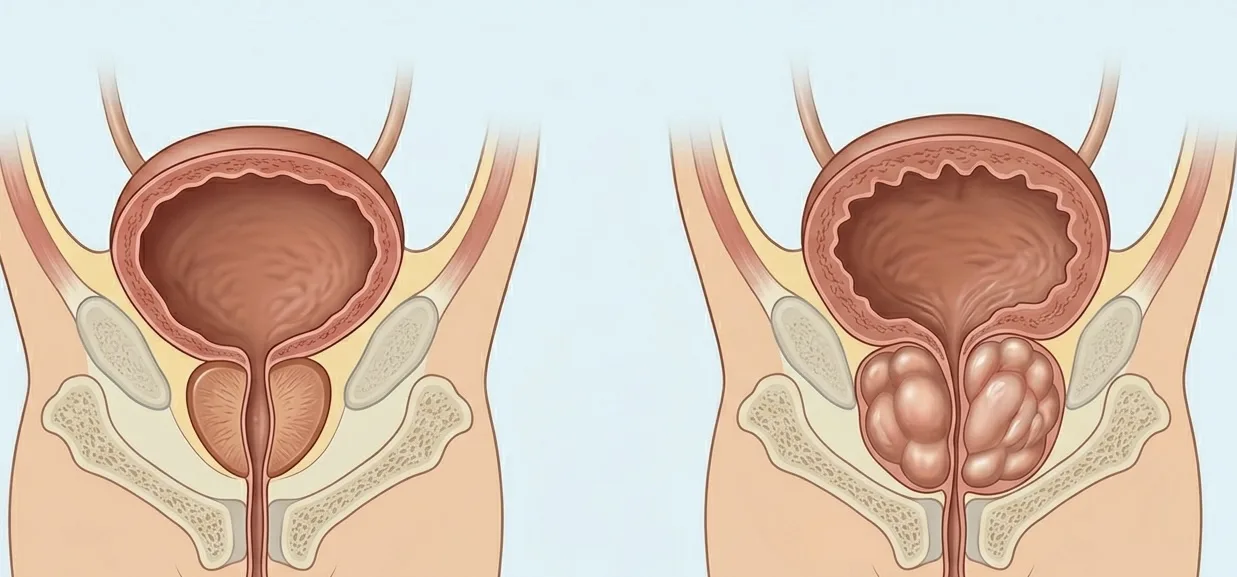
Frequent nighttime urination, weak stream, the feeling that the bladder hasn't fully emptied — if this sounds familiar, there is a high probability you have an enlarged prostate. Benign prostatic hyperplasia (BPH) affects more than half of men over 50, and the percentage increases with age.
Medications can alleviate symptoms but don't address the cause. When problems become pronounced or complications arise, surgical treatment is the right step. HoLEP prostate surgery is now considered the gold standard — here's why.
What Is HoLEP and How Is It Performed?
HoLEP (Holmium Laser Enucleation of the Prostate) is a minimally invasive laser prostate surgery that completely removes the enlarged tissue (adenoma) without any external incision.
The entire procedure is performed through the urethra using an endoscope and holmium laser. The process is easiest to understand through the analogy of peeling an orange: the laser separates the "pulp" — the adenomatous tissue causing urinary obstruction — from the "rind" — the surgical capsule of the prostate. The separated tissue is then pushed into the bladder, where a special instrument (morcellator) fragments and extracts it.
The key advantage of this approach is that the adenomatous tissue is removed in its entirety, rather than being cut away layer by layer as in the traditional TURP method. This is precisely why the results are more durable, and the need for reoperation is minimal.
Why Is HoLEP the Best Option for Treating Enlarged Prostate?
The European Association of Urology (EAU), whose guidelines represent the reference standard in urology worldwide, recommends HoLEP as the method of choice for surgical treatment of benign prostatic enlargement — regardless of gland size.
Complete Adenoma Removal — A Permanent Solution
Unlike other methods that remove only part of the tissue, HoLEP enucleation removes virtually all adenomatous growth. Studies with long-term follow-up show that the reoperation rate after HoLEP is below 2%, while with the traditional TURP method this percentage is significantly higher.
Effective for Prostates of All Sizes
Many surgical techniques are limited by prostate size. The HoLEP procedure is equally effective for prostates of 30 grams, as well as those exceeding 100 or even 200 grams — where previously the only option was open surgery with an abdominal incision.
Minimal Blood Loss
The holmium laser simultaneously cuts tissue and coagulates blood vessels. This means significantly less bleeding during the procedure compared to TURP. This is particularly important for patients taking anticoagulant or antiplatelet therapy (blood thinners).
Shorter Hospital Stay and Faster Recovery
Most patients leave the hospital on the first or second day after surgery. The urinary catheter is most commonly removed the day after the procedure. Return to daily activities is possible within one to two weeks.
Histopathological Analysis of Removed Tissue
All tissue removed during HoLEP is sent for histopathological examination. This provides a precise diagnosis in the same procedure — including the possibility of detecting early prostate cancer that was not identified through standard screening tests.
HoLEP Compared to Other Methods
| Characteristic | HoLEP | TURP | Open Surgery |
|---|---|---|---|
| Skin incision | No | No | Yes |
| Suitable for large prostates (>80g) | Yes | Limited | Yes |
| Average blood loss | Minimal | Moderate | Significant |
| Hospital stay | 1–2 days | 2–4 days | 5–7 days |
| Catheter after surgery | 1 day | 2–3 days | 7–14 days |
| Reoperation rate (10 yrs) | <2% | Up to 15–18% | Low |
| Tissue histopathology | Yes (complete) | Yes (fragments) | Yes (complete) |
How to Prepare for HoLEP Surgery?
Preparation for laser prostate surgery includes standard steps:
Laboratory tests — complete blood count, biochemistry, coagulation panel, blood type.
Urine culture — urine must be sterile. If an infection is present, antibiotic therapy is administered beforehand.
Urological examination — includes prostate ultrasound, uroflowmetry (urine flow measurement), and completion of the IPSS questionnaire that quantifies symptom severity.
Anesthesiological assessment — the procedure is most commonly performed under spinal or general anesthesia.
Medication adjustment — if you are taking blood thinners or prostate medications (alpha-blockers, 5-alpha-reductase inhibitors), we will discuss potential dose changes or temporary discontinuation.
What to Expect During HoLEP Surgery?
The surgery takes an average of 60–90 minutes, depending on prostate size. You will not feel pain during the procedure.
An endoscope with a laser fiber is introduced through the urethra. The holmium laser precisely separates the adenomatous tissue from the prostate capsule and pushes it into the bladder. The morcellator then fragments and aspirates the tissue. At the end of the procedure, a urinary catheter is placed to allow irrigation and drainage during the initial hours.
Recovery After HoLEP Surgery — Phase by Phase
First 24–48 Hours
The catheter is usually removed on the first day after surgery. Pink-tinged urine is a normal occurrence and resolves spontaneously within the following days. Most patients go home the same or the next day.
First to Second Week
Increased urinary frequency and mild urgency are possible — this is a normal tissue response to healing. Avoiding heavy physical activity and lifting is recommended.
After One Month
Most patients notice significant improvement: stronger urine stream, less frequent nighttime awakening, and complete bladder emptying. The follow-up visit includes uroflowmetry and the IPSS questionnaire to objectively document progress.
Long-Term
Studies with follow-up exceeding 10 years confirm that improvement achieved through HoLEP is maintained permanently. The prostate cannot regrow because the adenomatous tissue has been completely removed.
HoLEP Surgery Cost
| HoLEP — holmium laser enucleation of the prostate | RSD 360,000 |
The price covers the surgical procedure at Aurora General Hospital and excludes hospital stay, anaesthesiology consultation and pre-operative diagnostics. The final price depends on your findings — please check the current price list — Aurora General Hospital.
Frequently Asked Questions About HoLEP
Is HoLEP surgery painful?
The procedure is performed under anesthesia — you feel nothing during the operation. Post-operative discomfort is minimal and effectively managed with standard pain relievers. Most patients do not describe the post-operative period as painful.
What is HoLEP's impact on erectile function?
HoLEP does not impair erectile function. Research shows that potency outcomes are comparable to or even better than TURP, thanks to less thermal energy affecting surrounding tissue.
What is retrograde ejaculation?
Most patients experience retrograde ejaculation after HoLEP — semen travels to the bladder instead of outward during orgasm. This does not affect the sensation of orgasm, libido, or general health. The semen is subsequently excreted with urine. It is important that you are informed about this phenomenon before surgery.
Is HoLEP safe for elderly patients?
Yes. HoLEP is a safe procedure for elderly patients as well, including those with comorbidities (cardiovascular disease, diabetes). Minimal blood loss and shorter anesthesia duration make it suitable for patients with higher operative risk.
Who are candidates for HoLEP surgery?
HoLEP is indicated for men with lower urinary tract symptoms due to benign prostatic hyperplasia, in whom medical therapy is insufficiently effective or complications have developed: residual urine, recurrent urinary infections, bladder stones, or impaired bladder function.
How long does full recovery take?
Most patients return to light daily activities within 7–10 days. Full recovery, including physical activity and sports, is expected after 4–6 weeks.
Patients from the Serbian diaspora and international patients are welcome — the practice regularly treats patients travelling to Belgrade for urological care.