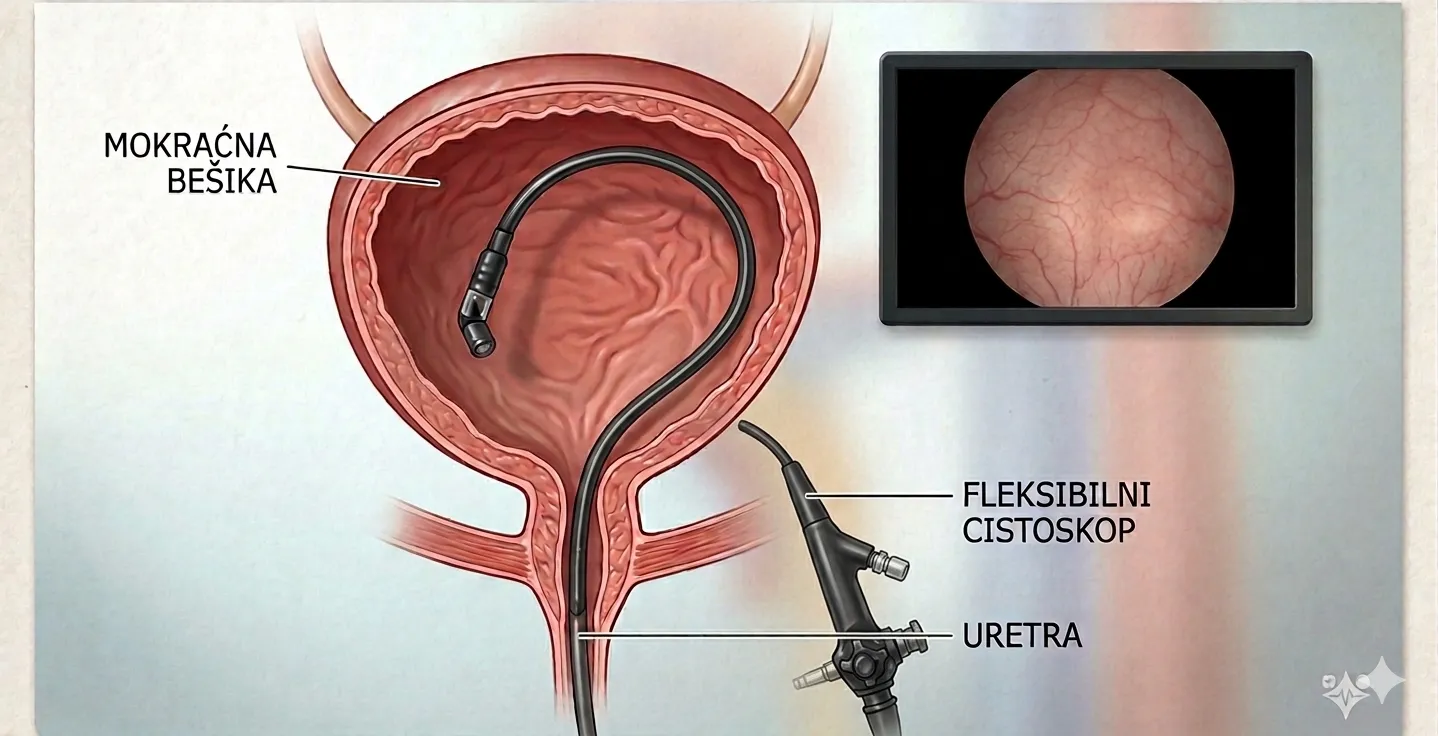
For many patients, the word "cystoscopy" triggers anxiety even before they fully understand what the procedure involves. The reason is simple: most people have only heard stories about the "classic" (rigid) cystoscopy, performed with a straight metal instrument. The good news is that a far more comfortable alternative has become the modern standard — flexible cystoscopy. Used routinely in leading European centres, this procedure delivers exactly what matters most to the patient: significantly less pain, greater comfort, and immediate recovery.
In this article I will explain what flexible cystoscopy is, how it differs from the rigid version, what its advantages are for the patient, and when it is used.
What is a cystoscopy?
A cystoscopy is an examination of the urethra and urinary bladder using a thin, camera-tipped instrument called a cystoscope. The urologist inserts the instrument through the urethra and views the inside of the bladder in real time on a monitor. This allows direct visualisation of the bladder lining, stones, tumours, inflammatory changes, or foreign bodies such as ureteral stents.
Cystoscopy is the most precise diagnostic examination of the bladder — no other method (ultrasound, CT scan, urinalysis) provides direct visualisation of the bladder mucosa.
There are two types of cystoscopes:
- Rigid cystoscope — a straight, metal instrument that does not bend.
- Flexible cystoscope — a thin, bendable instrument that follows the natural curves of the urethra.
Flexible vs. rigid cystoscopy — what's the difference?
This is the most important distinction for the patient, so let me explain it simply.
Rigid cystoscopy is performed with a straight metal instrument under local anaesthesia — an anaesthetic gel is instilled into the urethra before the procedure. The issue lies in the instrument itself: because the urethra (particularly in men) is not straight, the rigid cystoscope must be "guided" through its natural curves. Even with local anaesthesia, this often produces significant discomfort and pain.
Flexible cystoscopy is performed with a thin, bendable instrument that adapts to the patient's anatomy, not the other way around. The procedure is done in the office using the same type of local anaesthetic gel. The patient is awake, lies relaxed, and goes home immediately after the examination. The entire procedure takes just a few minutes, and the experience is markedly gentler.
In short:
- Rigid cystoscopy = straight metal instrument that does not follow the curves of the urethra = more discomfort and pain during and after the procedure.
- Flexible cystoscopy = thin, bendable instrument that adapts to the urethra = minimal discomfort and fast recovery.
Advantages of flexible cystoscopy for the patient
Based on clinical experience, these are the benefits patients consistently highlight.
1. Significantly less pain and greater comfort
This is the single biggest and most important advantage for the patient. The flexible cystoscope is thinner than the rigid one and follows the natural curves of the urethra — it does not "push" through them. With local anaesthetic gel, most patients describe the examination as a mild discomfort, not pain. Patients who have previously undergone rigid cystoscopy are consistently surprised by how different the experience feels.
2. Performed as an outpatient procedure
Flexible cystoscopy is done in the office as an outpatient procedure. The patient arrives, has the examination, and returns immediately to normal activities — driving, working, or travelling.
3. Shorter and simpler procedure
Flexible cystoscopy takes about 5 to 10 minutes. Preparation is minimal — no fasting, no preoperative workup, no ECG or blood tests as required for surgery.
4. Immediate results — findings on the spot
Because the urologist visualises the bladder live, the findings are discussed on the spot. No waiting for an additional report for the cystoscopy itself — we review the findings together as soon as the examination is complete.
5. Suitable for more sensitive patient groups
Because of the thinner instrument and excellent tolerance with only a local anaesthetic gel, flexible cystoscopy is especially well suited for women, elderly patients, patients with cardiac, pulmonary, or neurological conditions, and those with urethral stricture — in other words, for everyone in whom rigid cystoscopy would cause significantly more discomfort.
6. Lower risk of complications
Because the instrument is flexible and thinner, the risk of injury to the urethral lining is significantly lower compared with rigid cystoscopy. Bleeding after the examination is minimal or absent.
When is flexible cystoscopy performed? (Diagnostics)
Flexible cystoscopy is primarily a diagnostic examination. The most common reasons a urologist recommends it are:
- Blood in the urine (hematuria) — to rule out bladder tumours
- Recurrent or persistent urinary tract infections
- Suspected bladder tumour or surveillance in patients previously treated for bladder cancer
- Persistent voiding problems — difficulty urinating, weak stream, urgency
- Suspected urethral stricture
- Unexplained bladder-area pain
- Monitoring of bladder condition in patients with enlarged prostate
Flexible cystoscopy and JJ stent removal
One of the most important practical applications of flexible cystoscopy is the removal of a double-J (JJ) ureteral stent. A JJ stent is a thin tube placed between the kidney and bladder in patients who have undergone stone surgery (e.g., FURS — laser stone removal) or other urological interventions.
Today, in the vast majority of patients, the JJ stent is removed by flexible cystoscopy in the office — quickly, with only local anaesthetic gel, and without hospitalisation. The patient is in and out in a short visit: the stent is grasped with a thin instrument passed through the flexible cystoscope and withdrawn. The entire procedure takes only a few minutes.
For patients who have undergone stone surgery, this is a major improvement in recovery — stent removal is no longer "another operation" but a routine outpatient visit. More on what is normal with a stent and what removal looks like: JJ stent after FURS — a patient guide.
What does the procedure look like?
So that patients preparing for the examination know exactly what to expect:
- Arrival and preparation — the patient arrives at the office; no fasting is required.
- Local anaesthesia — anaesthetic gel is instilled into the urethra and works over 3–5 minutes to reduce sensation.
- Examination — the patient lies relaxed while the urologist carefully advances the flexible cystoscope through the urethra into the bladder. The bladder is gently filled with sterile fluid for clearer visualisation.
- Live examination — the mucosa of the bladder and urethra are inspected on the monitor. JJ stent removal can be performed at this point if needed.
- Completion — the instrument is gently withdrawn; the examination is over.
- Discussion of findings — we discuss the findings and next steps immediately after the examination.
The entire office visit averages 20–30 minutes; the examination itself 5–10.
How does the patient feel after the examination?
Most patients experience mild discomfort on first urination after flexible cystoscopy — this is normal and transient. You may notice:
- Mild burning during urination for a day or two
- A small amount of blood in the urine (pinkish colour)
- Slightly more frequent urination on the first day
We recommend increased fluid intake (2–2.5 litres of water) over the next 24–48 hours — this flushes the urinary tract and speeds recovery. If symptoms persist or a fever develops, contact the urologist.
Examination Cost
| Flexible cystoscopy (Specialist Practice S) | RSD 25,000 |
| Urology consultation | RSD 6,000 |
| Urology consultation with urinary tract ultrasound | RSD 8,000 |
Prices apply to outpatient services at Specialist Practice S. Please check the current price list — Specialist Practice S.
Frequently asked questions about flexible cystoscopy (FAQ)
Does flexible cystoscopy hurt?
No. With local anaesthetic gel, most patients describe it as a brief discomfort, not pain.
How long does flexible cystoscopy take?
The examination itself takes 5 to 10 minutes; the entire office visit 20 to 30 minutes.
Is antibiotic prophylaxis required before flexible cystoscopy?
In healthy patients, routine antibiotic prophylaxis is not required. It is recommended selectively — for patients with long-term catheters, immunosuppression, prosthetic heart valves, or a history of recurrent urinary tract infections — and the decision is made by the urologist based on clinical assessment and urine culture.
When can I have sexual intercourse after cystoscopy?
A 24 to 48 hour pause is recommended until any mild burning or urethral irritation resolves. After that, there are no restrictions.
Can flexible cystoscopy be performed during pregnancy?
Yes, when medically justified (e.g., unexplained hematuria or suspected tumour). Because it is performed under local anaesthetic gel, without radiation and without general anaesthesia, it is safe in selected indications during pregnancy — always in consultation with the obstetrician.
How often should follow-up cystoscopy be done for bladder tumours?
The schedule depends on the tumour's type, grade, and risk category. Typically, surveillance is done every 3 months during the first 1–2 years, with longer intervals thereafter. The exact plan is determined by the urologist based on the pathology report and EAU (European Association of Urology) guidelines.
Can a JJ stent be removed with flexible cystoscopy?
Yes — in the vast majority of patients, JJ stent removal is performed as an outpatient procedure, without hospitalisation.
How much does flexible cystoscopy cost in Belgrade?
The cost depends on the type of examination (diagnostic or with JJ stent removal). For exact pricing and availability, contact +381 65 2161 665 or visit ordinacija-s.com.
Conclusion — why flexible cystoscopy changes the patient experience
Flexible cystoscopy is the modern standard in bladder diagnostics. For the patient, it means one simple thing — better diagnostics with significantly less pain, greater comfort, and no hospitalisation.
If your urologist has recommended a cystoscopy, or if you have symptoms that call for a bladder examination (blood in the urine, recurrent infections, voiding problems), don't delay. Early detection is decisive in urology — and today there is no reason for fear of the procedure to keep you from having it done.
Patients from the Serbian diaspora and international patients are welcome — the practice regularly treats patients travelling to Belgrade for urological care.
Flexible cystoscopy with Dr Cvijanović can be booked in Belgrade at Specijalistička ordinacija S (Dragana Rakića 50), by phone +381 65 2161 665.