Severe flank pain radiating down toward the groin, blood in the urine, nausea — if you've experienced this, you've likely been diagnosed with a kidney or ureteral stone. Kidney stones affect approximately 12% of men and 5% of women during their lifetime, and many experience recurrence.
Smaller stones are often passed naturally by the body. However, when a stone is too large, causes severe pain, or threatens to damage the kidney — intervention is needed. Today, there is a procedure that solves this problem without a single incision on the skin, through natural body openings, with the help of a laser. It's called FURS — flexible ureterorenoscopy with laser lithotripsy.
What Is FURS and How Does It Work?
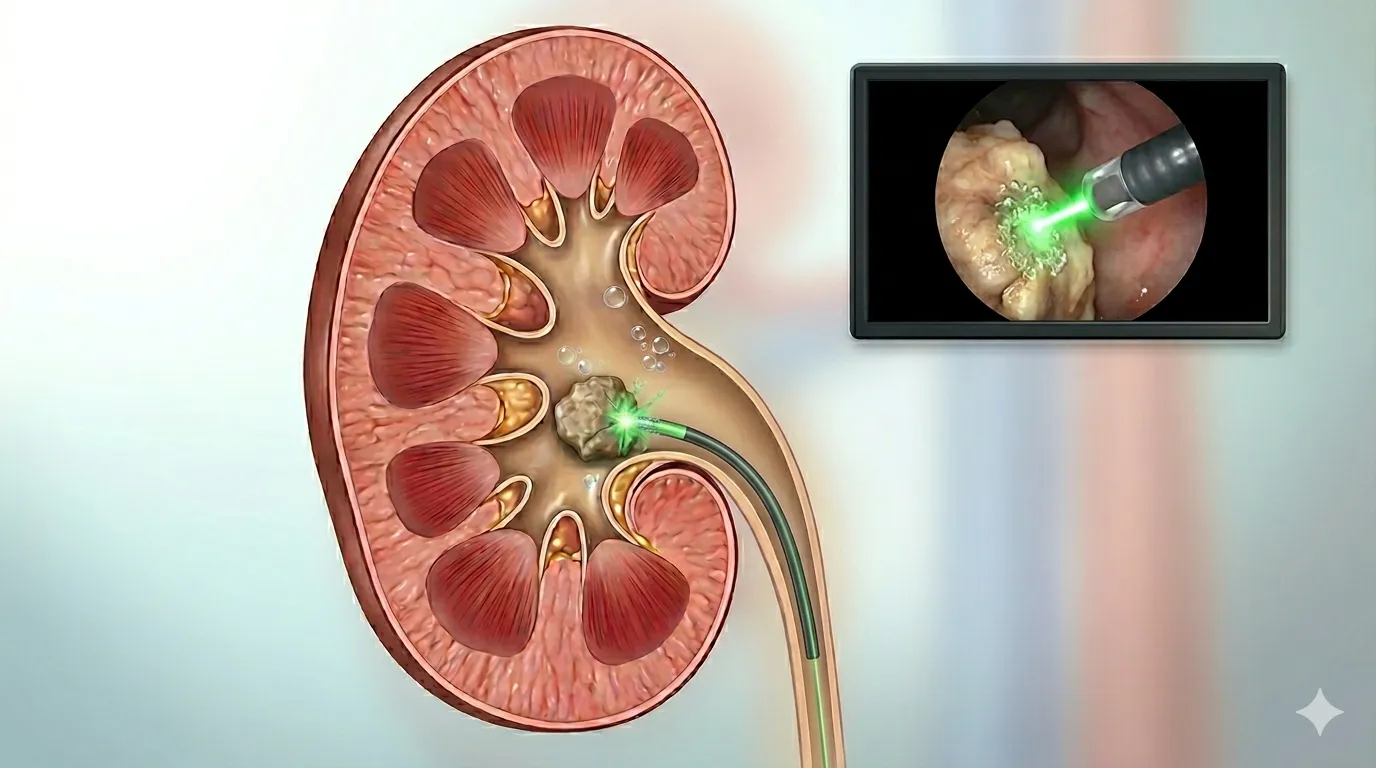
FURS (Flexible Ureterorenoscopy) is a minimally invasive endoscopic procedure that accesses the kidney and ureter through natural body openings — no cuts, no punctures, no scars.
The urologist introduces an ultra-thin flexible instrument — a ureterorenoscope — through the urethra and bladder. The instrument has a camera and light source at its tip and can bend in all directions, allowing access to all parts of the kidney's collecting system, including the narrowest renal calyces that rigid instruments cannot reach.
Once the stone is located, a laser fiber is introduced through the working channel of the ureterorenoscope. The holmium laser emits precise energy that breaks the stone into tiny fragments or dust (the so-called "dusting" technique). These small remnants are then spontaneously expelled with urine over the following days and weeks.
When Is FURS with Laser Lithotripsy the Right Choice?
FURS is particularly suitable in the following situations:
Kidney stones up to 2 cm. For stones of this size, FURS with laser lithotripsy is the first-line treatment according to European Association of Urology (EAU) guidelines.
Ureteral stones. The flexible approach allows access to stones at any level of the ureter.
Patients on anticoagulant therapy. Since the procedure is minimally invasive and incision-free, FURS is a safer choice for patients taking blood-thinning medications.
Stones in collecting system anomalies. Thanks to the instrument's flexibility, it is possible to access stones even in anatomically atypical renal calyces.
Patients for whom ESWL was unsuccessful. If shock wave lithotripsy (ESWL) did not produce results, FURS with laser is the logical next step.
FURS Compared to Other Kidney Stone Treatment Methods
| Characteristic | FURS + Laser | ESWL (Shock Waves) | PCNL (Percutaneous) |
|---|---|---|---|
| Skin incision | No | No | Yes (small, 1 cm) |
| Anesthesia | General | No anesthesia (analgesics) | General |
| Ideal stone size | Up to 2 cm | Up to 1–1.5 cm | Over 2 cm |
| Success rate (1 session) | 85–95% | 60–75% | 90–95% |
| Real-time visual control | Yes | No | Yes |
| Hospital stay | 1 day (discharge next day) | Outpatient | 2–4 days |
| Recovery | 3–7 days | 1–3 days | 2–3 weeks |
| Suitable for anomalies | Yes | No | Partially |
How to Prepare for a FURS Procedure?
Preparation for laser kidney stone removal involves several steps:
CT urography. An imaging study that precisely shows the size, location, and number of stones, as well as the anatomy of the kidney's collecting system. This is a key diagnostic step that enables procedure planning.
Laboratory tests. Complete blood count, biochemistry, coagulation status, and urine culture. Urine must be sterile — if an infection is present, antibiotic therapy is administered beforehand.
Anesthesiology consultation. FURS is most commonly performed under general anesthesia, although spinal anesthesia may be possible for some patients.
Medication adjustment. If you take blood-thinning medications, we will discuss a possible pause or dose adjustment.
Prior JJ stent placement. In some cases, particularly with larger stones or a narrow ureter, the urologist may place a ureteral stent one to two weeks before the procedure. The stent widens the ureter and facilitates instrument passage on the day of surgery.
What Does the Procedure Look Like?
The procedure is performed under general anesthesia and takes on average 30–60 minutes, depending on the size and number of stones.
The urologist first introduces a semirigid ureterorenoscope through the urethra to explore the ureter. A guidewire is then placed through the ureter, and an access sheath is introduced over it to provide a stable working channel. Only then is the flexible ureterorenoscope introduced through the access sheath to reach the kidney. The camera at the tip of the instrument transmits high-resolution images to a monitor, enabling precise navigation.
When the stone is visualized, a laser fiber is introduced through the instrument's working channel. The laser can operate in two modes: fragmentation (breaking into larger pieces that are then extracted with baskets) or dusting (converting the stone into fine dust that is spontaneously expelled with urine). The choice of technique depends on the stone's size and hardness.
At the end of the procedure, the urologist typically places a JJ stent — a thin flexible tube connecting the kidney and bladder that ensures unobstructed urine drainage. The stent is removed in an outpatient setting after 1–4 weeks. Everything about what is normal with a stent, when to call your doctor and how removal works is covered in a separate article: JJ stent after FURS — a patient guide.
Recovery After Laser Kidney Stone Removal
First 24 hours
Most patients go home the next day. Mild discomfort during urination and pinkish urine are possible — this is normal and resolves spontaneously.
First week
Mild flank pain or discomfort during urination is possible, especially if a JJ stent has been placed. The stent may cause a feeling of frequent urination and mild discomfort — this is an expected reaction and should not cause concern. Generous fluid intake (2–3 liters daily) is recommended to accelerate the flushing of small fragments.
After 1–4 weeks
The JJ stent is removed in an outpatient setting by flexible cystoscopy — the procedure takes just a few minutes. After that, most patients feel completely normal. In detail about living with a stent and its removal: JJ stent — why it is placed, how long it stays and how it is removed.
Follow-up examination
A follow-up ultrasound or CT is performed 4–6 weeks after the procedure to confirm that all fragments have been removed and that the kidney is functioning normally.
Advantages of FURS with Laser Lithotripsy
No incisions or scars. The entire procedure is performed through natural body openings. No skin incisions, no sutures, no scars.
High success rate. Studies show a complete stone removal rate of 85–95% in a single session, significantly higher compared to the ESWL method.
Real-time visual control. Unlike ESWL where the stone is targeted "blindly," with FURS the surgeon sees the stone directly on screen and controls every laser movement.
Fast recovery. Return to daily activities is possible within 3–7 days. Most patients go home the next day.
Applicable in complex cases. Anatomical anomalies, stones in lower calyces, multiple stones — FURS can reach where other methods cannot.
Stone analysis. Fragments can be sent for chemical analysis, helping identify the cause and prevent recurrent stone formation.
FURS Procedure Cost
| Flexible ureterorenoscopy with laser lithotripsy | RSD 235,000 |
| Re-FURS (repeat procedure) | RSD 155,000 |
| Semirigid ureterorenoscopy with laser lithotripsy | RSD 155,000 |
The price covers the surgical procedure at Aurora General Hospital and excludes hospital stay, anaesthesiology consultation and pre-operative diagnostics. The final price depends on your findings — please check the current price list — Aurora General Hospital.
Frequently Asked Questions About FURS
Is FURS painful?
The procedure is performed under general anesthesia — you feel nothing during the procedure. Postoperative discomfort is mild and is controlled with standard analgesics. Most of the discomfort patients describe is related to the JJ stent, not the procedure itself.
How long do I stay in the hospital?
FURS is performed as a short hospitalization in most cases. This means you arrive on the day of the procedure, and if everything goes well — you go home the following morning.
What is a JJ stent and why is it placed?
A JJ stent is a thin flexible tube with hooks on both ends (hence the name "double J"). One end sits in the kidney, the other in the bladder. The stent ensures that urine drains freely from the kidney after the procedure. It is removed in an outpatient setting after 1–4 weeks — the process is quick and simple.
Can stones form again?
Unfortunately, yes. The recurrence rate for kidney stones is approximately 50% within 10 years. This is precisely why chemical analysis of the removed stone, metabolic evaluation, and correction of risk factors are important — primarily adequate fluid intake, adapted diet, and medical prophylaxis when needed.
Can FURS damage the kidney?
FURS is a safe procedure with a very low complication rate. Serious complications are extremely rare. The most common side effects are transient hematuria (blood in urine) and mild stent discomfort — both resolve spontaneously.
Which stones can't FURS treat?
For very large stones (over 2–2.5 cm), particularly staghorn stones that fill the entire renal collecting system, percutaneous nephrolithotripsy (PCNL) is recommended. FURS can also be used as a supplementary procedure after PCNL for residual stone fragments.
How to Prevent Kidney Stones from Recurring?
Prevention is equally important as treatment. Here are the key measures:
Drink enough fluids. The goal is to produce at least 2–2.5 liters of urine daily. This typically requires an intake of 3 liters or more, especially in warm months and during physical activity.
Stone analysis. Every removed stone should be sent for chemical analysis. The type of stone (calcium oxalate, urate, phosphite, cystine) directly determines dietary recommendations and potential medical prophylaxis.
Adjust your diet. Depending on stone type: reduce salt and animal protein intake for oxalate stones, limit purines for urate stones, adjust urine acidity for phosphate stones.
Regular check-ups. An annual kidney ultrasound enables early detection of new stones while they are still small and easily treatable.
Patients from the Serbian diaspora and international patients are welcome — the practice regularly treats patients travelling to Belgrade for urological care.