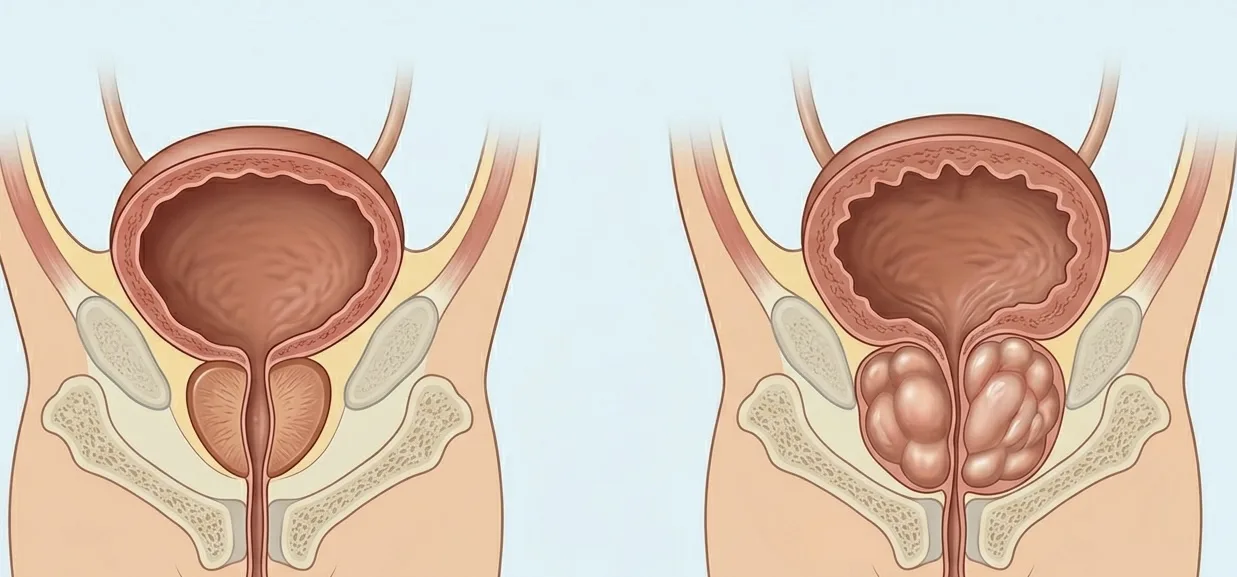
More than half of men over 50 have an enlarged prostate. After 80, that number rises above 80%. Benign prostatic hyperplasia — or BPH — is not cancer and does not turn into cancer, but it can seriously impair quality of life: frequent night-time waking, weak stream, a sense of incomplete bladder emptying, and in severe cases the inability to urinate at all.
The good news: BPH is one of the most successfully treated conditions in urology today. Most patients respond to medication, and when medication is not enough, modern surgery — above all HoLEP holmium laser enucleation of the prostate — provides a durable solution with minimal trauma and rapid recovery.
This guide walks you through everything you need to know: why the prostate enlarges, what the typical symptoms are, how a urologist makes the diagnosis, and what all the treatment options are — from diet and medication to laser surgery.
What is benign prostatic hyperplasia (BPH)?
The prostate is a gland the size of a chestnut, located beneath the bladder and surrounding the urethra. Its role is to produce part of the fluid that makes up semen. After the age of 40, hormones — primarily dihydrotestosterone (DHT) — begin to drive new cell growth in the central part of the prostate, the so-called transition zone. This enlargement compresses the urethra that runs through the prostate, like squeezing a garden hose.
The result is obstruction of urine flow — and that is the source of all BPH symptoms. Two important points to understand:
- Enlargement is not the same as severe symptoms. Some men with significantly enlarged prostates have minimal complaints; others with relatively small prostates have prominent symptoms. What matters is how much the obstruction is compressing the urethra.
- BPH is not cancer. It is a benign enlargement that never turns into prostate cancer. But the two conditions can coexist in the same patient, so the workup always rules out both.
How common is BPH?
BPH is part of the natural ageing process in men. The statistics are striking:
- About 25% of men in their 40s have histological signs of BPH (when tissue is examined).
- About 50% of men over 50 have clinically manifest BPH.
- Over 80% of men over 80 have BPH.
But only half of those with BPH develop symptoms severe enough to seek help. Others live with mild complaints that they either attribute to ageing or compensate for (e.g. by avoiding fluids in the evening). That is why BPH is often a "silent" condition — patients come in only when symptoms become unbearable or a complication develops.
Symptoms of an enlarged prostate
BPH symptoms are grouped under the medical acronym LUTS — Lower Urinary Tract Symptoms. They fall into three groups:
1. Obstructive symptoms (problems with voiding)
- Weak, thin stream — urination takes longer than before.
- Difficulty starting urination — especially in the morning, waiting for the stream to begin.
- Straining to urinate, using abdominal pressure.
- Stream interruption during urination.
- Sense of incomplete bladder emptying after urination.
- Dribbling after urination ends.
2. Irritative symptoms (problems with bladder filling)
- Frequent daytime urination (more than 8 times).
- Nocturia — waking once or more at night to urinate.
- Urgency — a sudden, strong need to reach the toilet immediately.
- Urge incontinence — occasional leakage of a few drops before reaching the toilet.
3. Post-voiding symptoms
- Post-micturition dribbling — leakage while getting dressed.
- Sense of incomplete emptying — which restarts the urge to urinate within 30–60 minutes.
Symptom severity is standardly measured with the IPSS (International Prostate Symptom Score) — seven questions the patient answers themselves. A score of 0–7 means mild symptoms, 8–19 moderate, and 20–35 severe. The IPSS is an excellent tool for tracking whether therapy is working: it is repeated after several weeks of treatment and the results compared.
Risk factors — why me?
You can't avoid them, but it helps to know what increases the likelihood of BPH:
- Age. The strongest factor — risk rises linearly after 40.
- Family history. If a father or brother had BPH (especially in their early 50s), risk is about 4 times higher.
- Ethnicity. Statistically higher incidence in men of African descent, lower in Asian populations.
- Obesity and metabolic syndrome. High BMI, abdominal obesity and insulin resistance are associated with faster prostate growth.
- Sedentary lifestyle. Less physical activity = greater risk.
- Diet rich in saturated fat and red meat. A Mediterranean diet is associated with lower risk.
- Type 2 diabetes. An independent risk factor.
When to see a urologist urgently
Most BPH symptoms develop gradually and are not urgent. But there are warning signs that require prompt evaluation:
- Complete inability to urinate (acute urinary retention) — abdominal distension, severe pain, requiring catheter placement.
- Blood in the urine (hematuria) — always requires evaluation to rule out bladder or prostate cancer.
- High fever, chills and flank pain — may indicate urosepsis or pyelonephritis (kidney infection).
- Severe obstructive symptoms worsening over a few days, especially with nausea and vomiting (may indicate kidney blockage).
If any of these apply — don't wait for a routine appointment, go to the emergency department or contact us immediately.
How is BPH diagnosed?
The goal of the first visit is twofold: to determine whether symptoms truly come from BPH (and not another condition), and to assess severity in order to choose the right therapy. The standard diagnostic pathway includes:
History and IPSS questionnaire
A discussion of complaints, medications the patient is taking (many blood pressure drugs, antihistamines, antidepressants and anticholinergics can worsen symptoms), comorbidities and family history. The patient completes the IPSS questionnaire.
Physical examination — DRE (digital rectal examination)
The urologist palpates the prostate through the rectum. The exam takes about ten seconds and is not painful. It assesses size, consistency, symmetry and tenderness of the prostate. Hard, asymmetric areas are a sign for further workup (PSA, biopsy), while a soft, smoothly enlarged prostate is typical of BPH.
Laboratory tests
- PSA (prostate-specific antigen) — a blood test that helps assess the risk of prostate cancer. PSA can be elevated in BPH as well (especially with large prostates) — it is interpreted together with size as "PSA density".
- Urine (urine culture, sediment) — rules out a urinary tract infection that can mimic BPH symptoms.
- Creatinine — checks kidney function; high creatinine with BPH symptoms is a serious warning sign.
Uroflowmetry
The patient urinates into a special device that measures stream rate. A Qmax (peak flow rate) below 10 ml/s indicates obstruction, 10–15 ml/s is borderline, and above 15 ml/s is normal. The test is painless and takes as long as a single voiding.
Ultrasound and post-void residual measurement
Transabdominal ultrasound measures prostate size (in grams), bladder wall thickness (thickening indicates long-standing obstruction) and — most importantly — the volume of urine remaining in the bladder after voiding (post-void residual, PVR). A PVR over 100 ml indicates significant obstruction.
Transrectal ultrasound of the prostate (TRUS)
Provides more accurate prostate volume measurement — important for choosing therapy and surgical method. It is mandatory before any surgery.
Cystoscopy
Examination of the urethra and bladder with a flexible instrument — performed when concurrent conditions (bladder stones, tumor) are suspected, or before surgery. More details in our guide on flexible cystoscopy.
Urodynamics (when needed)
The most precise method for distinguishing obstruction from detrusor (bladder muscle) weakness. Indicated in younger patients, in neurological diseases, or before revision surgery.
Treatment options for an enlarged prostate
Treatment is chosen based on symptom severity, prostate size, presence of complications and the patient's overall health. There are four main levels:
1. Watchful waiting
For patients with mild symptoms (IPSS < 8) and no complications — lifestyle changes and an annual check-up are recommended. Many men in this category never develop a need for medication.
Tips: limit fluid intake 2 hours before bed, reduce coffee and alcohol, regular physical activity, weight control, and avoid medications that worsen symptoms (when possible, in consultation with your doctor).
2. Medications
Alpha-blockers (tamsulosin, alfuzosin, silodosin, doxazosin) relax smooth muscle in the bladder neck and prostate. The effect starts within one to two weeks. Most common side effects: dizziness on standing, retrograde ejaculation (harmless), rarely nasal congestion.
5-alpha reductase inhibitors — 5-ARIs (finasteride, dutasteride) block the conversion of testosterone to DHT, gradually shrinking the prostate. Full effect at 3–6 months. They are indicated for prostates larger than 30–40 ml. They can affect libido and erectile function in a small percentage of patients.
Combination therapy (alpha-blocker + 5-ARI) is the most effective option for patients with a large prostate and severe symptoms — it reduces the risk of progression and surgery.
Tadalafil 5 mg (a drug from the same class as Cialis) is also approved for the treatment of BPH, especially in patients who also have erectile dysfunction.
Herbal supplements (saw palmetto, nettle, palm) — popular and harmless, but with modest evidence of efficacy. They can help with mild symptoms but do not replace proper therapy in moderate to severe cases.
3. Minimally invasive procedures
Techniques such as Rezūm (water vapor therapy), UroLift (mechanical lifting of prostate lobes) and TUMT (microwave thermotherapy) are used in selected patients in whom medications fail and conventional surgery is not ideal.
4. Surgical treatment
Surgery is indicated when: medications don't help, symptoms are very severe, or complications have developed (retention, bladder stones, bleeding, recurrent infections, impaired kidney function).
Three main options:
- HoLEP (holmium laser enucleation of the prostate) — today the gold standard in European Association of Urology guidelines. Laser removal of the entire adenoma through the urethra, without an incision. Effective for prostates of all sizes, with minimal bleeding and a short hospital stay. Details in our guide on HoLEP prostate surgery.
- TURP (transurethral resection of the prostate) — the classic operation; tissue is removed layer by layer. Effective for prostates up to ~80 g; more bleeding than HoLEP.
- Open prostatectomy — surgery with an abdominal incision, traditionally for large prostates (>100 g) — increasingly rare, since HoLEP achieves the same results without an incision.
Complications of untreated BPH
Although BPH does not turn into cancer, long-untreated disease can lead to serious complications:
- Acute urinary retention — sudden inability to urinate, requiring urgent catheter placement.
- Recurrent urinary tract infections due to residual urine that is an ideal medium for bacteria.
- Bladder stones — form in residual urine.
- Hematuria — bleeding from enlarged veins on the surface of the prostate.
- Hydronephrosis and kidney damage — when high bladder pressure begins to back urine up into the kidneys.
- Bladder diverticula — outpouchings of the bladder wall that empty poorly.
Patients often endure and "wait out" symptoms, putting themselves at risk for the complications above.
Prevention and lifestyle
BPH cannot be fully prevented — but the risk and rate of progression can be reduced:
- Regular physical activity — at least 150 minutes of moderate activity per week.
- Weight control — obesity is an independent risk factor.
- Mediterranean diet — vegetables, fruit, fish, olive oil; less red and processed meat.
- Tomatoes and lycopene — some studies suggest a protective effect.
- Zinc and healthy fats — pumpkin seeds, nuts, fish.
- Limit alcohol and coffee — especially in the evening.
- Annual check-ups after age 50, earlier if there is family history of BPH or prostate cancer.
Frequently asked questions
Does an enlarged prostate mean cancer?
No. BPH and prostate cancer are two different conditions. BPH is a benign enlargement that doesn't turn into cancer. But both can produce similar symptoms, so the examination always rules out both — through a combination of DRE, the PSA test, and additional workup when needed.
Can I live with BPH without treatment?
If symptoms are mild (IPSS < 8) and don't interfere with quality of life, watchful waiting with lifestyle changes can be enough. But with significant complaints, waiting increases the risk of complications — from bladder stones to kidney damage.
How long do I need to take prostate medications?
Alpha-blockers are usually taken indefinitely as long as they remain effective and well tolerated. 5-ARIs are also used long-term — stopping causes the prostate to return to its previous size. Treatment is guided by a urologist with regular follow-ups.
If medications work for me, will I ever need surgery?
Not necessarily. Many patients use medications successfully for years. But about 5% of patients per year experience progression that requires surgical treatment — most often due to acute retention or the appearance of complications.
What is the difference between HoLEP and TURP?
Both operations remove the adenoma through the urethra without an incision, but HoLEP enucleates the entire adenoma — like peeling an orange — while TURP cuts layer by layer. The result: HoLEP works for prostates of any size, has minimal bleeding and longer-lasting results. Details in the HoLEP surgery guide.
Does prostate surgery affect sex life?
HoLEP does not impair erectile function. The most common change is retrograde ejaculation — semen goes into the bladder instead of out, which does not affect orgasm or health. Fertility may be impaired, which is important to know for men who still plan to father children.
How long is recovery after HoLEP?
Most patients leave the hospital on the first or second day, return to office work in 7–10 days, and reach full physical fitness in 4–6 weeks. Details in the recovery section of our HoLEP guide.
Next step — book a consultation
If you recognize the symptoms in yourself or a loved one, the most important step is not to wait. The earlier the diagnostic workup begins, the simpler the treatment and the more likely it is that medications and lifestyle changes will be enough.
At the first visit we'll go through your symptoms together, complete the IPSS, do a DRE, ultrasound and uroflowmetry, and build a plan tailored to your situation. Book a urological appointment — by phone or contact form.
For international patients, we organize examination, diagnostics and consultation in a single day. Write to us in advance — we'll help align everything with your stay in Belgrade.