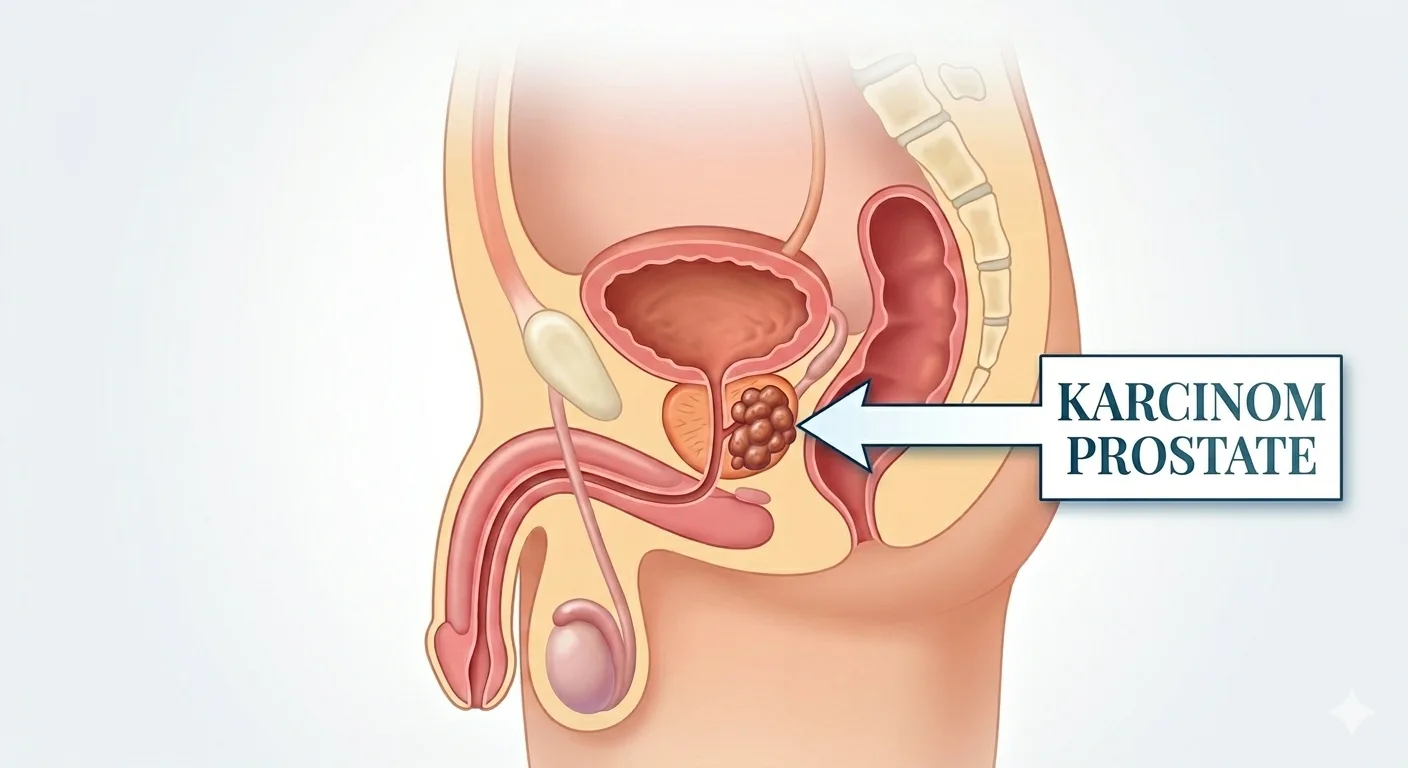
Prostate cancer is the second most common cancer in men worldwide. The lifetime risk of diagnosis is about 1 in 8 men. But there is also an encouraging side: when detected early, localized prostate cancer has survival of over 99% in the first 5 years. The key is timely diagnosis — before the disease leaves the prostate.
Diagnosis has changed significantly in recent years. The routine path is no longer "elevated PSA → biopsy of all patients". Today the standard is PSA → mpMRI of the prostate → targeted biopsy only when there is a specific suspicious zone. This has reduced the number of unnecessary biopsies while increasing the accuracy of detecting clinically significant tumors.
This guide covers: why it occurs, how we monitor risk, what mpMRI and the Gleason score actually mean, all the treatment options today — from active surveillance to robotic prostatectomy — and what life looks like after diagnosis.
What is prostate cancer?
Prostate cancer is a malignant disease arising from the glandular cells of the prostate. In over 95% of cases it is an adenocarcinoma. The tumor usually develops in the peripheral zone of the prostate — the part that can be palpated on a digital rectal examination — which is the difference compared with benign prostatic hyperplasia (BPH), which involves the central transition zone.
Most prostate cancers grow slowly. Statistics show that many men "die with prostate cancer rather than from it" — particularly with low-risk tumors detected at older ages. That is why modern guidelines do not recommend aggressive treatment of every detected tumor; active surveillance is much more than "waiting" — it is a structured follow-up program.
Risk factors
The three strongest factors — age, family and ethnicity — cannot be changed, but knowing about them shapes how and when you start screening.
- Age. Risk rises exponentially after 50. Before 40, prostate cancer is rare.
- Family history. A father or brother with prostate cancer doubles the risk. More relatives or younger-age diagnoses — even higher risk.
- Ethnicity. Men of African descent have up to a 60% higher risk and earlier onset.
- Genetic mutations. BRCA1, BRCA2, HOXB13 and Lynch syndrome increase risk. BRCA2 in particular carries a high risk of aggressive disease.
- Diet. Rich in saturated fats and red meat, low in vegetables — associated with higher risk. A Mediterranean diet and lycopene (tomato) show a protective effect in some studies.
- Obesity. Linked to more aggressive forms of disease.
Symptoms — and why there often aren't any
The biggest pitfall of prostate cancer is that early stages usually produce no symptoms at all. The tumor grows in the peripheral part of the prostate, far from the urethra, so it does not interfere with urination until it reaches a significant size or extends beyond the prostate.
Symptoms that may eventually appear:
- Weak stream, frequent urination, nocturia — but these are also typical BPH symptoms, which makes them difficult to distinguish.
- Blood in urine or semen.
- Erectile dysfunction (often multifactorial).
- Back or bone pain — alarming; may indicate metastases.
- Weight loss and general weakness — later stages.
The message: don't wait for symptoms to see a urologist. Screening exists precisely because prostate cancer is "silent" at the stage when it is easiest to cure.
Screening — for whom and when?
Guidelines vary by region, but the general consensus is:
- Average-risk men — start the screening conversation at age 50.
- Positive family history or African ancestry — start at age 45.
- BRCA2 carriers and high-risk genetic profiles — from age 40.
- Stopping screening — usually after age 70–75 or when life expectancy falls below 10–15 years.
Screening uses a combination of PSA testing and DRE every 1–2 years, depending on baseline values and risk.
The diagnostic pathway — from PSA to diagnosis
1. PSA — prostate-specific antigen
PSA is a protein produced by the prostate. Elevated levels in the blood may indicate cancer — but also BPH, prostatitis or recent manipulation (DRE, cycling, ejaculation in the past 48 h, catheterization). That is why PSA is never interpreted alone.
Useful parameters:
- Absolute value — but without a fixed threshold; interpreted by age.
- Free/Total PSA ratio — a lower ratio (< 15%) raises suspicion for cancer.
- PSA density — PSA divided by prostate volume (measured by TRUS). Helps distinguish BPH from cancer.
- PSA velocity — annual rate of rise. A rise > 0.75 ng/ml/year is suspicious.
- 4Kscore, PHI, SelectMDx — additional blood/urine biomarkers, used in borderline cases.
2. DRE (digital rectal examination)
The urologist palpates the prostate through the rectum. Hard, asymmetric areas are suspicious. DRE and PSA are complementary — some cancers are found only on DRE and vice versa.
3. mpMRI of the prostate (multiparametric MRI)
It has become the standard next step when PSA or DRE raises suspicion. The exam takes 30–45 minutes and uses contrast. Lesions are classified by the PI-RADS system:
- PI-RADS 1–2 — low probability of cancer; biopsy often not needed; follow-up with repeat PSA.
- PI-RADS 3 — indeterminate; biopsy decision is individualized based on clinical context.
- PI-RADS 4–5 — high probability; biopsy is indicated, targeted to the suspicious zone.
4. TRUS biopsy of the prostate
Ultrasound-guided biopsy through the rectum (transrectal) or through the perineal skin (transperineal). Usually 10–14 systematic samples are taken, plus targeted samples from lesions identified on mpMRI (fusion biopsy). The procedure takes 10–15 minutes and is performed under local anesthesia or short general sedation.
Biopsy results show:
- Whether cancer is present.
- How many samples are positive and what percentage of each is involved.
- Gleason score and ISUP group (1–5) — the most important prognostic information.
5. Stage
The goal is to determine whether the tumor is localized or has spread. The following are used:
- Bone scan — examination of the skeleton.
- Abdominal and pelvic CT — lymph nodes and organs.
- PSMA PET/CT — the most modern method, very sensitive for small metastases; becoming standard for high-risk patients.
Risk classification
The combination of PSA, DRE, mpMRI and biopsy places the patient into one of these groups:
- Very low / low risk — Gleason 6 (ISUP 1), PSA < 10, clinical T1c–T2a. Often a candidate for active surveillance.
- Intermediate risk — Gleason 7 (ISUP 2 or 3), PSA 10–20, T2b. The largest group. Active treatment is usually indicated, with a choice between surgery and radiotherapy.
- High / very high risk — Gleason 8–10 (ISUP 4–5), PSA > 20, T2c and above. Multimodal approach (surgery + radiation + hormonal therapy).
- Metastatic — disease beyond the prostate. The goal is control, not cure.
Treatment options
1. Active surveillance
A structured program for low-risk patients. PSA every 3–6 months, DRE, repeat mpMRI/biopsy by protocol. The goal: avoid tumors that would never cause problems. Treatment is started only if signs of progression appear.
Studies with 10–15 years of follow-up have shown that survival is comparable to immediately treated patients — with significantly better quality of life.
2. Radical prostatectomy
Surgical removal of the entire prostate with the seminal vesicles and, if needed, regional lymph nodes. Three approaches:
- Open — through an abdominal incision; used less and less today.
- Laparoscopic — through several small incisions; less bleeding, faster recovery.
- Robotic (RARP) — laparoscopic with robotic instruments; provides the greatest precision in nerve-sparing techniques.
Hospital stay 1–3 days, catheter 7–10 days. Key risks: erectile dysfunction and temporary urinary incontinence; the nerve-sparing technique (when oncologically safe) significantly reduces both.
3. Radiotherapy
Two main groups:
- External beam radiotherapy (EBRT) — IMRT, VMAT, SBRT techniques; usually 5–8 weeks of treatment, daily 10–15 minute sessions. No incision, no catheter.
- Brachytherapy — placement of radioactive seeds directly into the prostate (LDR) or temporarily (HDR). Indicated for low/intermediate risk tumors.
Oncological outcomes are comparable to surgery for localized disease. The side-effect profile is different — less acute incontinence but more late changes in the bladder and rectum.
4. Hormonal therapy (ADT — androgen deprivation therapy)
Prostate cancer grows under the influence of testosterone. Lowering testosterone — surgically (orchiectomy) or with medication (LHRH agonists/antagonists) — slows tumor growth. It is used:
- Together with radiotherapy for high-risk localized tumors (synergistic effect).
- As primary therapy for metastatic disease.
- For biochemical recurrence after surgery or radiation.
Side effects include loss of libido, hot flashes, gynecomastia, loss of muscle mass and osteoporosis — careful monitoring and protective measures are needed.
5. Newer-generation therapies for advanced stages
Abiraterone, enzalutamide, apalutamide, darolutamide (second-generation antiandrogens); chemotherapy (docetaxel, cabazitaxel); radioisotopes (Lutetium-PSMA). Survival in metastatic prostate cancer has improved significantly over the past 10 years thanks to these drugs.
6. Focal therapy
Treatment of only the affected part of the prostate (instead of all of it) — HIFU (high-intensity focused ultrasound), cryotherapy, focal laser therapy. Selective for patients with unilateral tumors of low to intermediate risk. The goal: preserve erectile and urinary function. Still being more broadly validated, available in specialized centers.
Life after diagnosis and treatment
Prostate cancer is a disease in which quality of life is one of the central goals, since many patients are diagnosed at an active age. The three most common questions:
Erectile function
Surgery and radiation can leave lasting effects. Strategies: nerve-sparing technique in surgery, early rehabilitation (PDE5 inhibitors — Cialis, Viagra), vacuum devices, intracavernosal injections, and as a last resort a penile implant. Realistic expectations are key — don't idealize.
Urinary continence
Temporary urine leakage after surgery is expected. Kegel exercises before and after surgery significantly speed up recovery. Most patients regain full control in 3–12 months. A small percentage have permanent incontinence which can be treated with a sling or an artificial sphincter.
Fertility
Surgery and radiation destroy fertility. For men still planning to have children, sperm cryopreservation should be recommended before treatment.
Prevention and screening — what you can do
- Regular screening in agreement with your urologist — the most important measure.
- Mediterranean diet — vegetables, fish, olive oil, tomato (lycopene), green tea.
- Less red and processed meat.
- Weight control.
- Physical activity — at least 150 minutes of moderate exercise per week.
- Limit alcohol and stop smoking.
- Discussion of family history and, when indicated, genetic testing (BRCA).
Frequently asked questions
Does an elevated PSA mean cancer?
Not automatically. PSA can be elevated due to BPH, prostatitis, recent ejaculation or prostate manipulation. The next step is usually a repeat PSA and, if persistently elevated, an mpMRI.
What is the Gleason score?
A pathologist evaluates how the tumor looks under the microscope and assigns two scores from 1 to 5. They are added (e.g. 3+4=7). A lower score (6) indicates slow-growing, less aggressive tumors. A higher score (8–10) indicates aggressive disease. The ISUP grouping simplifies this: 1 (Gleason 6), 2 (3+4=7), 3 (4+3=7), 4 (Gleason 8), 5 (Gleason 9–10).
Is the biopsy painful?
With modern local anesthesia and careful technique, discomfort is minimal — most patients feel only brief pressure or "pinching" as samples are taken. The procedure lasts 10–15 minutes. After the biopsy, mild blood in the urine and semen and slight discomfort for 1–2 days are possible.
Can I have prostate cancer if my PSA isn't elevated?
Yes, rarely. Some cancers do not produce much PSA. That is why PSA is always combined with a DRE, and with symptoms or suspicion an mpMRI is performed regardless of PSA.
What is the difference between cancer and BPH?
BPH is a benign enlargement of the prostate that does not turn into cancer. Cancer is a malignant disease. The two can coexist in the same patient. Details about BPH are in our guide on enlarged prostate.
Is robotic surgery better than laparoscopic?
Robotic surgery offers mechanical precision that facilitates nerve-sparing techniques and reconstruction. Oncological outcomes are comparable with an experienced laparoscopic surgeon. The difference lies more in the surgeon's comfort and reduced fatigue during long operations — which translates into less variance in results.
Can prostate cancer be fully cured?
Yes, when localized. The 5-year survival for localized prostate cancer is over 99%. Early diagnosis is key. Even in metastatic disease, modern therapies can extend life with good quality for years and decades.
Next step
If you have an elevated PSA, a palpable change on DRE, a family history, or simply want to begin a screening program — the best time for an examination is now. The goal of the first visit is to build an individualized plan: when to repeat PSA, whether mpMRI is needed already, which tests to expand.
Book a urological appointment — by phone or contact form. For international patients: the diagnostic pathway can be organized in a single visit, with a written summary in English for your home doctor on return.