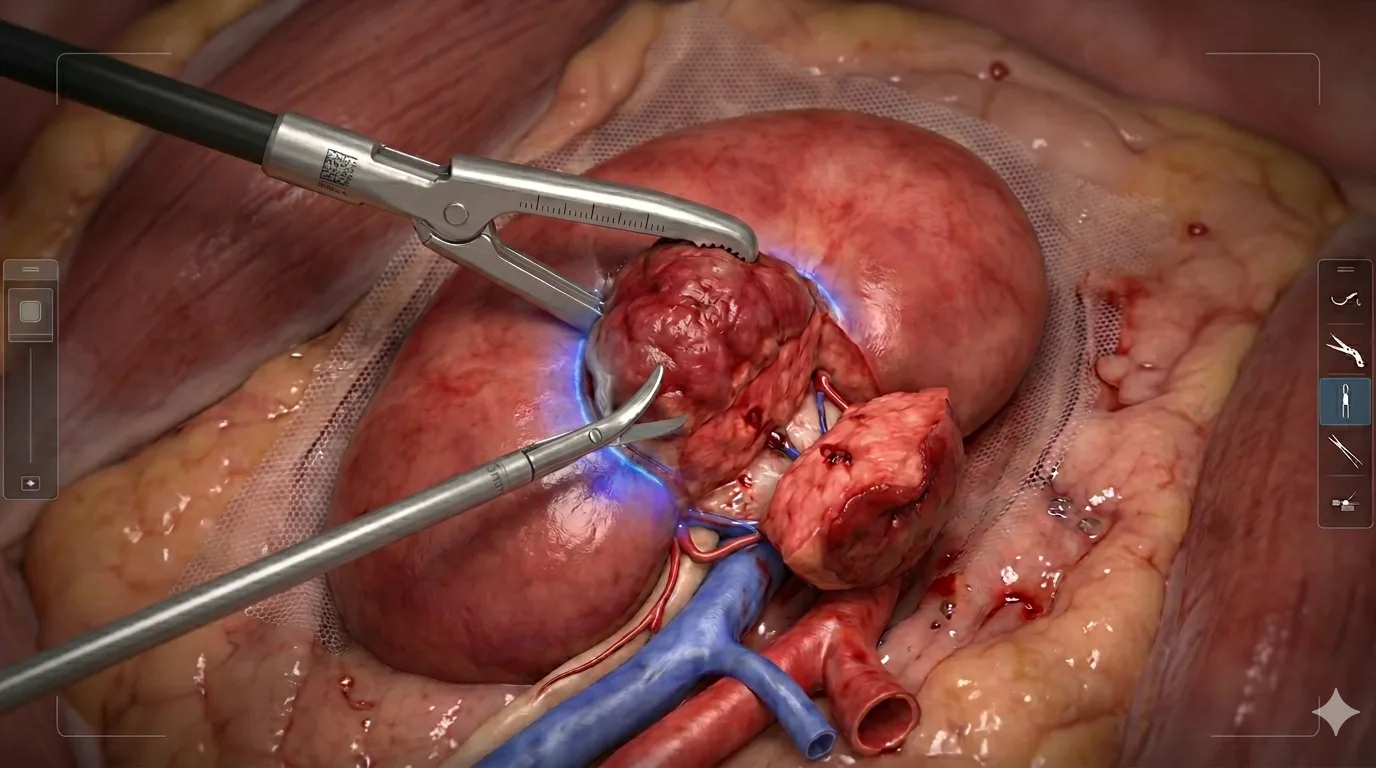
Kidney tumors are most often discovered incidentally today — on an ultrasound or CT scan performed for an entirely different reason. This is precisely why more and more tumors are found at an early stage, while they are small and completely curable with surgery. The good news is that in most cases this surgery can be performed laparoscopically — through a few incisions smaller than one centimeter, instead of a large flank incision.
In this article I explain when the entire kidney is removed in kidney cancer (radical nephrectomy), when it is possible to preserve the kidney and remove only the tumor (partial nephrectomy), what the operation looks like, and what to expect during recovery.
What Is Kidney Cancer and How Is It Detected?
Renal cell carcinoma (RCC) is the most common malignant kidney tumor in adults — accounting for about 90% of all malignant tumors of this organ. It is more common in men and most often occurs between the ages of 60 and 70. Risk factors include smoking, obesity, high blood pressure, and family predisposition.
Small kidney tumors typically cause no symptoms at all. The classic signs — blood in the urine, flank pain, and a palpable mass — are rarely seen today and usually indicate advanced disease. That is why most kidney tumors are discovered incidentally, during an abdominal ultrasound or CT examination.
Once a tumor is detected, a contrast-enhanced CT or MRI follows, precisely showing the size, location, and relationship of the tumor to the blood vessels and collecting system of the kidney. The type of operation is planned based on these findings.
Radical or Partial Nephrectomy — What Is the Difference?
Radical nephrectomy involves removing the entire kidney together with the surrounding fatty tissue. It is performed for larger tumors, tumors involving the central part of the kidney, or when kidney preservation is technically not feasible.
Partial nephrectomy (kidney-sparing surgery) involves removing only the tumor with a thin margin of healthy tissue, while the rest of the kidney is preserved. According to the European Association of Urology (EAU) guidelines, partial nephrectomy is the treatment of choice for tumors up to 4 cm (stage T1a), and in selected cases it is also performed for tumors of 4 to 7 cm.
Why is preserving the kidney important? Every preserved portion of functional kidney tissue reduces the risk of chronic kidney disease, cardiovascular complications, and the need for dialysis later in life. At the same time, the oncological outcomes of partial and radical nephrectomy for small tumors are equivalent — the chance of cure is not sacrificed.
| Feature | Partial nephrectomy | Radical nephrectomy |
|---|---|---|
| What is removed | Only the tumor with a margin of healthy tissue | The entire kidney with surrounding fat |
| Typical tumor size | Up to 4 cm (selected cases up to 7 cm) | Larger and centrally located tumors |
| Kidney function | Maximally preserved | Taken over by the other kidney |
| Duration of surgery | Under 2 hours | Under 2 hours |
| Oncological outcome for small tumors | Equal to radical | Equal to partial |
Why Laparoscopic Rather Than Open Surgery?
Open kidney surgery requires a 15–20 cm incision on the flank or abdomen, often with muscle division. Laparoscopic surgery performs the same operation through 3–4 incisions of 5 to 12 millimeters, through which a high-resolution camera and thin instruments are introduced.
Less pain. Small incisions mean a significantly lower need for painkillers after surgery.
Less blood loss. The magnified image and precise control of blood vessels reduce bleeding during the procedure.
Shorter hospital stay. After laparoscopic nephrectomy, patients are usually discharged within 3 days, while the stay after open surgery is typically longer.
Faster return to activities. Return to daily routines is possible within 2–3 weeks, compared with 6–8 weeks after open surgery.
Equal oncological safety. Numerous studies confirm that long-term outcomes of laparoscopic kidney cancer treatment are equal to those of open surgery.
Open surgery still has its place — for very large tumors, tumors with thrombus in the great veins, or in patients with multiple previous abdominal operations.
How Do You Prepare for the Operation?
Contrast-enhanced imaging. CT or MRI of the abdomen precisely shows the tumor, the kidney's blood vessels, and the function of the opposite kidney — the basis for planning the procedure.
Laboratory tests. Complete blood count, biochemistry with kidney function parameters, coagulation status, and urinalysis.
Anesthesiology assessment. The operation is performed under general anesthesia, so an anesthesiologist's evaluation is mandatory, especially in patients with comorbidities.
Medication adjustment. Blood thinners are paused or replaced as agreed with the surgeon and cardiologist.
What Does the Operation Look Like?
The procedure is performed under general anesthesia. Through a small incision near the navel, carbon dioxide is introduced into the abdominal cavity to create working space, and then ports are placed — short tubes through which the camera and instruments pass.
In radical nephrectomy, the surgeon first identifies and safely ligates the main renal artery and vein, then frees the kidney with its surrounding fatty tissue. The kidney is removed in a special retrieval bag through a slightly extended incision and sent for pathological analysis.
In partial nephrectomy, the kidney's blood vessels are temporarily clamped so the tumor can be removed in a bloodless field. The tumor is excised with a thin margin of healthy tissue, the defect is sutured, and blood flow through the kidney is then re-established. The time without blood flow (so-called warm ischemia) is kept under 20–25 minutes, which preserves kidney function.
At the end of the procedure, a thin drain is usually left in place and removed after a day or two.
Recovery After Laparoscopic Kidney Surgery
First days in hospital
You are up and walking on the first day after surgery, and your diet gradually returns to normal. Pain is usually mild and well controlled with standard painkillers. Discharge from hospital usually follows 3 days after the procedure.
First two weeks at home
Light activities and walking are recommended, while avoiding lifting loads over 5 kg. The small incisions heal quickly, and any discomfort gradually subsides.
After 2–3 weeks
Most patients return to work and daily activities. Sports and heavier physical exertion are postponed for 4–6 weeks after surgery.
Pathology report
The definitive tissue report arrives within 2–3 weeks. It confirms the tumor type, its stage, and whether it was completely removed — and the follow-up plan is made based on it.
Follow-Up After Kidney Cancer Surgery
For localized kidney cancer, surgery is usually the only treatment needed — no radiation and no systemic therapy. Follow-up consists of periodic check-ups including laboratory tests and imaging (ultrasound, CT) at intervals that depend on the stage and aggressiveness of the tumor.
The goal of follow-up is twofold: early detection of any recurrence and preservation of the remaining kidney tissue's function. Patients are advised to stop smoking, control blood pressure and body weight, and moderate their salt intake.
Surgery Cost
| Laparoscopic radical nephrectomy | RSD 490,000 |
| Laparoscopic partial nephrectomy | RSD 600,000 |
| Open radical nephrectomy | RSD 420,000 |
The price covers the surgical procedure at Aurora General Hospital and excludes hospital stay, anaesthesiology consultation and pre-operative diagnostics. The final price depends on your findings — please check the current price list — Aurora General Hospital.
Frequently Asked Questions
Is the whole kidney always removed in kidney cancer?
No. For smaller tumors (typically up to 4 cm, and in selected cases up to 7 cm), partial nephrectomy is performed — only the tumor is removed with a narrow margin of healthy tissue, preserving most of the kidney. The decision depends on tumor size, location, and the patient's overall condition.
Can I live a normal life with one kidney?
Yes. A healthy remaining kidney takes over the function, and most patients live completely normal lives. Regular annual kidney function checks, blood pressure control, and avoiding kidney-straining medications without medical advice are recommended.
How long does laparoscopic kidney tumor surgery take?
Both radical and partial laparoscopic nephrectomy typically take under 2 hours, depending on the size and location of the tumor and anatomical circumstances.
How long is the hospital stay?
Usually 3 days. You are up and walking on the first postoperative day, and return to daily activities is possible within 2–3 weeks.
Is laparoscopic surgery as safe as open surgery?
Yes. Studies consistently show equivalent oncological outcomes, while laparoscopy brings less pain, less blood loss, a shorter hospital stay, and faster recovery. For certain very large or complex tumors, open surgery remains the safer choice.
Is systemic therapy needed after the operation?
For localized kidney cancer, systemic therapy is generally not needed. For localized tumors, surgery is usually sufficient; for advanced disease, modern immunotherapy and targeted therapy are considered in consultation with an oncologist.
Conclusion
Kidney cancer detected at an early stage is a curable disease. Laparoscopic surgery allows both radical and partial nephrectomy to be performed without a large incision — with less pain, a shorter hospital stay, and a faster return to normal life, without compromising oncological safety. If a kidney lesion has been described on your ultrasound or CT scan, do not postpone a urology consultation — timely diagnosis and surgery give the best results.